
London / Tokyo, – 14th June 2026
FLOWRA and ORE Catapult Sign New Memorandum of Understanding on Subsea Engineering
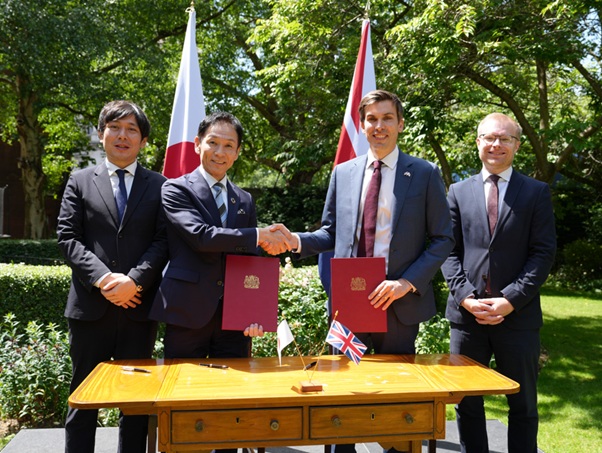
Photo caption from left to right:
Mr. Noriyoshi FUKUOKA, Director of Wind Business Promotion at METI Japan.
Mr. Masakatsu Terazaki, Chairperson of FLOWRA
Mr. Andrew Stormonth-Darling, Head of Floating Offshore Wind at ORE Catapult
Mr. Michael Shanks, the Minister of State for Energy, the United Kingdom
The Floating Offshore Wind Technology Research Association (FLOWRA) and Offshore Renewable Energy (ORE) Catapult signed a Memorandum of Understanding (MOU) on 14 June 2026 at 10 Downing Street, the Prime Minister’s Office in London, to collaborate on the development of subsea engineering technologies for floating offshore wind.
FLOWRA and ORE Catapult previously signed a MOU on 7 March 2025 with the aim of exploring comprehensive technical development collaboration in the field of floating offshore wind. The new MOU on subsea engineering technology development represents an important step in giving additional focus to the collaboration set out in the earlier MOU.
The MOU was signed by Masakatsu Terazaki, Chairperson of FLOWRA, and Andrew Stormonth-Darling, Head of Floating Offshore Wind at ORE Catapult, and witnessed by Mr. Michael Shanks MP, the Minister of State for Energy , and by Mr. Noriyoshi FUKUOKA, Director of Wind Business Promotion at Ministry of Economy, Trade and Industry (METI) Japan.
With FLOWRA and ORE Catapult serving as the principal coordination hubs, the MOU aims to further strengthen bilateral collaboration between industry and public research institutions in Japan and the United Kingdom, and through the establishment and operation of a subsea engineering technology development framework, the initiative seeks to achieve a substantial and early reduction in the construction costs of offshore wind projects.
Specifically, with the collaboration of government agencies in both countries, the initiative is intended to contribute to improving the competitiveness of offshore wind power by establishing a system utilizing robotics and digital technologies that enables year-round subsea construction work, including during the harsh winter seasons, and by integrating this organically with conventional offshore construction methods.
FLOWRA, as a technology research association, promotes the research and development of common technologies for floating offshore wind through collaboration with relevant organisations in Japan and overseas, with the objective of reducing both cost and risk.
ORE Catapult is a UK research and technology organisation established in 2013 to enable innovation and accelerate the development of offshore renewable energy, growing businesses and creating jobs throughout the UK. Through their world-class testing and research programmes and unique centres of excellence, they work with industry, academia and government to improve technology reliability and enhance knowledge, directly impacting the cost of offshore renewable energy.
Comment from Masakatsu Terazaki, Chairperson of FLOWRA Board of Directors
Since the Paris Agreement came into force in 2016, the international community has continued to make steady progress towards the realisation of a decarbonised society, despite facing difficulties at times. At the same time, there has perhaps never been a period in recent years when the importance of securing a stable energy supply has been so widely recognised across society. I believe that floating offshore wind is an extremely important option in addressing the dual challenges of decarbonisation and energy security.
However, floating offshore wind will not become embedded in society based on ambition and expectation alone. It can only become a sustainable industry by overcoming, one by one, the practical realities of natural conditions, construction, maintenance, human resources, supply chains and commercial viability. I believe that when discussing technology, we must never forget our responsibility to the people on the ground who support it, to local communities and to future generations.
Since the beginning of this century, many stakeholders around the world have worked to advance the deployment of floating offshore wind and have demonstrated its technical feasibility. However, to achieve full-scale adoption and industrialization, further risk reduction and cost cutting are essential.
Since FLOWRA signed its first MOU with ORE Catapult last spring, we have engaged in dialogue with many like-minded stakeholders and have jointly built a systems integration framework incorporating an innovation community known as The Moonshot. It is therefore highly significant that we are now able to sign a further MOU with ORE Catapult, our first collaboration partner, on subsea engineering technology development, and to take a more concrete step towards resolving these challenges.
Clear development targets that provide visibility of demand and support market formation are essential to reducing the cost of floating offshore wind. However, relying solely on economies of scale will not be sufficient. We expect that the establishment and operation of this subsea engineering technology development framework will enable year-round subsea construction work, allowing for an earlier start to power generation and significantly improving the economic viability of floating offshore wind. We also believe that these technologies will have a positive impact on fixed-bottom offshore wind and other marine energy.
The United Kingdom has deep knowledge and extensive experience in offshore development, as well as a forward-looking spirit that uses innovation as a lever for new growth. Japan, on the other hand, has cultivated industries by refining technologies through manufacturing and by building quality and reliability over time. Physical AI, which combines digital industrial infrastructure with real-world technologies, will also play an important role in future national growth strategies.
With Japan and the United Kingdom at the forefront, and by working together with those whom we have collaborated across countries and regions, we will bring together advanced knowledge and practical insight to open new possibilities in subsea engineering. There is no shortcut, but we believe that addressing the challenges with sincerity, maintaining a clear focus on implementation, and moving forward step by step with all stakeholders is the surest path to early cost reduction and real-world deployment of floating offshore wind.
Comment from Andrew Stormonth-Darling, Head of Floating Offshore Wind, ORE Catapult
“The signing of this new MoU with FLOWRA signifies ever closer ties between our two organisations and countries. . The selection of the topic of Subsea Technologies for Floating Wind is hugely relevant to the sector and marks a significant opportunity for cost reduction and bringing projects to fruition quicker.
“The focus of the MoU is designed to complement the shared experience and capabilities of the offshore wind sector in both countries. The UK’s long track record of offshore energy engineering combined with the advanced technological capabilities of many Japanese companies can combine to great effect.
“The floating wind industry has a vast potential to provide clean, home-grown power to many nations around the world, and international partnerships such as this are hugely valuable in accelerating our journey to that destination.”
++++++++++
Contact:
Floating Offshore Wind Technology Research Association (FLOWRA)
Inside CROSSCOOP, Urbannet Uchisaiwaicho Building, 3F
1-1-13, Shimbashi, Minato-ku, Tokyo, 〒105-0004
E-Mail:info@flowra.or.jp
Web: https://flowra.or.jp/en/
LinkedIn: https://www.linkedin.com/company/flowrajapan/
Offshore Renewable Energy Catapult (ORE Catapult)
Inovo Building, 121 George St, Glasgow G1 1RD UK
Email: media@ore.catapult.org.uk
Website: https://ore.catapult.org.uk/
LinkedIn: https://www.linkedin.com/company/offshore-renewable-energy-catapult/